


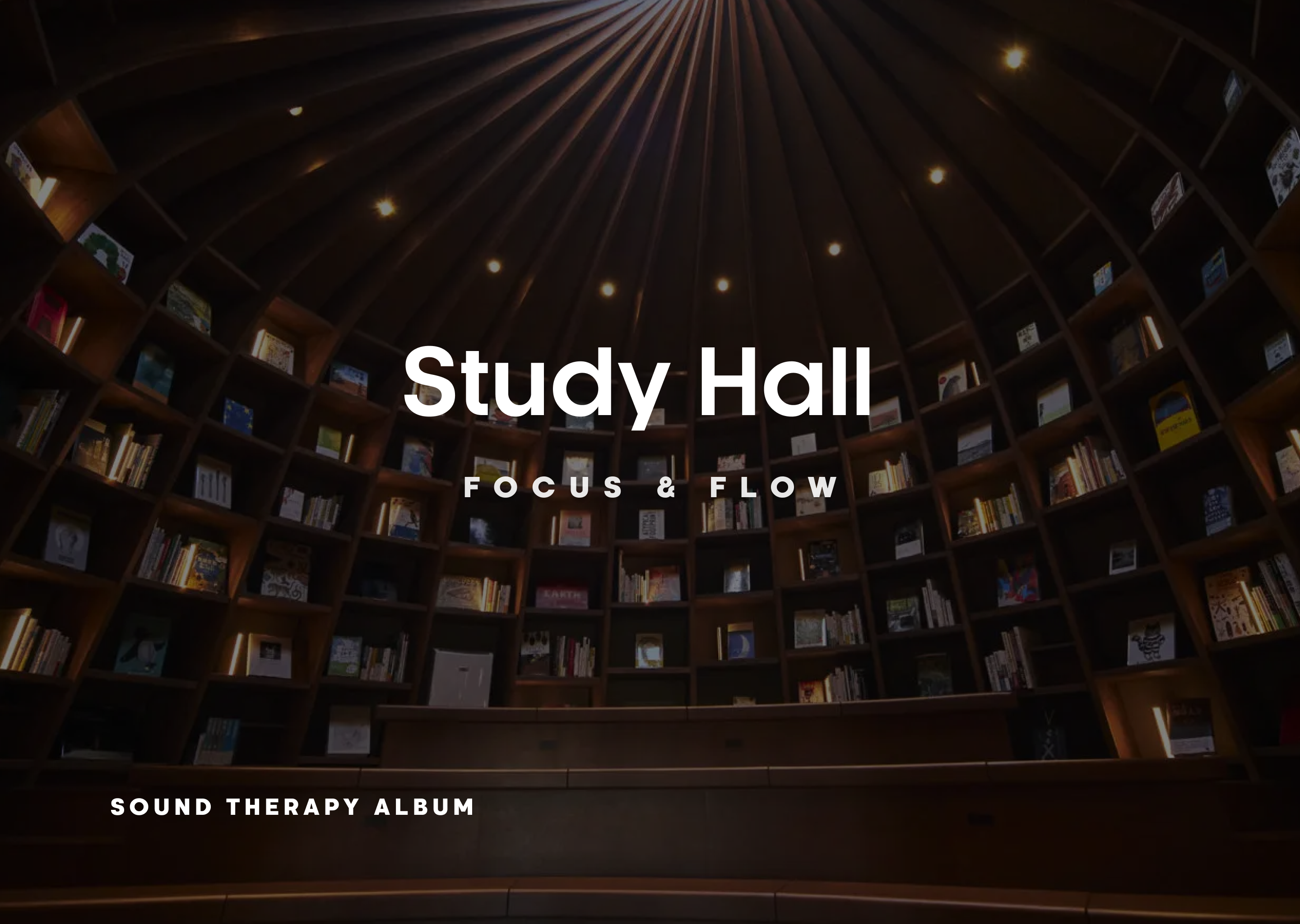
It’s a six-track “sound pharmacy” designed to help you focus, reset, and create from a clearer, calmer mind.
Why “Study Hall” Exists
We live in a world built to hijack attention, from endless feeds to nonstop notifications, and it’s training our brains into scattered, high-alert states that make deep focus feel impossible. Study Hall was created as an antidote to that, an invitation to remember that your mind is not broken, just overstimulated, and fully capable of clarity, flow, and restoration.
At the heart of the album is one simple principle: where attention goes, energy flows, and over time your brain literally rewires around what you repeatedly focus on. Modern neuroscience shows that focused mental states shape neural firing patterns, while chronic stress and distraction pull those patterns toward survival mode instead of creativity and presence.
The Science Behind the Sound
Study Hall uses brainwave entrainment: carefully tuned frequencies that help your brain shift from scattered to coherent, focused rhythms. Research on 40Hz “gamma” stimulation shows that this frequency can enhance neural synchronization, support cognitive function, and has even been explored as a tool for brain health in aging and neurodegenerative conditions.
The album also aligns with work on the “relaxation response,” a measurable state of deep physiological rest shown to improve markers like heart rate, blood pressure, oxygen use, and even gene expression related to stress and inflammation. These findings echo what Study Hall is built to do: move you out of constant fight-or-flight and back into a balanced, resilient state.
Your Personal Sound Pharmacy
Think of Study Hall as a toolkit you can reach for depending on what your day demands.
Tracks:
- Dynamic Focus: For laser clarity when you need to cut through mental fog and get work done.
- NeuroNarrative: For direction and decision-making when you feel lost, journaling, or mapping your next chapter.
- Brain Reboot: For digital detox after long hours of scrolling, calls, and screen time.
- Focus Fusion: For long study blocks, deep work, and extended concentration.
- Mindset Momentum: For moments when motivation is low and you need courage and forward energy.
- Creative Flow: For dissolving creative blocks and opening the channel for new ideas, writing, designing, or making anything from scratch.
Each track pairs intention with frequency: you match the sound to your situation, press play, and let your nervous system recalibrate while you work, reflect, or simply rest.
How to Use It in Real Life
You don’t need a complex ritual, just simple, repeatable moments.
- Morning: Before opening your phone, use Dynamic Focus or Mindset Momentum to set the tone for the day.
- Work blocks: Choose Dynamic Focus, Focus Fusion, or Creative Flow depending on whether you need precision, stamina, or inspiration.
- Midday: Run Brain Reboot as a reset after heavy screen time or information overload.
- Evening: Close your day with NeuroNarrative to process, integrate, and listen to your own inner guidance.
One powerful way to deepen the practice is to keep a small notebook nearby and jot down what you notice after each session, energy shifts, ideas, clarity, or changes in how you handle stress.
A Return to Mental Sovereignty
Study Hall is ultimately about sovereignty: remembering that your focus is yours to direct, and that your mind is a living system capable of profound self-repair when given the right environment. Work in fields like epigenetics and mind-body medicine points toward how environment, perception, and intention can influence our biology and even gene expression, reinforcing the idea that we are far less “fixed” than we once believed.
Every time you choose sound over scrolling, intention over autopilot, you are training your brain toward clarity instead of chaos. Study Hall is here as a companion in that process, a sonic reminder that deep focus, creativity, and calm are not rare states reserved for a few, but your natural baseline waiting to be reclaimed.
Stream Vibes AI Study Hall wherever you stream your music.
Sources
[1] Evidence that 40Hz gamma stimulation promotes brain health is … https://news.mit.edu/2025/evidence-40hz-gamma-stimulation-promotes-brain-health-expanding-0314
[2] Unleashing the potential: 40 Hz multisensory stimulation therapy for … https://pmc.ncbi.nlm.nih.gov/articles/PMC11952037/
[3] Long-term effects of forty-hertz auditory stimulation as a … - PNAS https://www.pnas.org/doi/10.1073/pnas.2529565123
[4] Relaxation Response | Ohio State Integrative Medicine https://wexnermedical.osu.edu/integrative-health/resources/relaxation-response
[5] Relax, Repeat | Harvard Medical School https://hms.harvard.edu/news/relax-repeat
[6] The Relaxation Response Herbert Benson, M.D. Harvard University … https://www.brighamandwomensfaulkner.org/assets/Faulkner/headache-center/documents/relaxation-response.pdf
[7] Bruce Lipton, PhD: The Jump From Cell Culture to Consciousness https://pmc.ncbi.nlm.nih.gov/articles/PMC6438088/
[8] The Biology of Belief: Interview with Dr. Bruce Lipton (Part 1) https://www.theclearingnw.com/blog/biology-of-belief-summary-dr-bruce-lipton-part-1
[9] Study suggests 40Hz sensory stimulation may benefit … - MIT News https://news.mit.edu/2025/study-suggests-40hz-sensory-stimulation-may-benefit-some-alzheimers-patients-1114
[10] New Video: An update about our gamma research - Tsai Lab - MIT https://tsailaboratory.mit.edu/new-video-an-update-about-our-gamma-research/
[11] Evidence expanding that 40Hz gamma stimulation promotes brain … https://picower.mit.edu/news/review-evidence-expanding-40hz-gamma-stimulation-promotes-brain-health
[12] 40Hz Light and Sound (Flat 10kHz) Gamma Brainwave Used in MIT … https://www.youtube.com/watch?v=ZyOMipUT_1g
[13] Bruce Lipton, a pioneering cell biologist, proposes a fascinating … https://www.facebook.com/groups/354201317256809/posts/779264718083798/
[14] In Down syndrome mice, 40Hz light and sound improve cognition … https://picower.mit.edu/news/down-syndrome-mice-40hz-light-and-sound-improve-cognition-neurogenesis-connectivity
[15] The Relaxation Response - Wikipedia https://en.wikipedia.org/wiki/The_Relaxation_Response






No Comments.